Austin’s long warm season means pools may be used frequently, and the combination of heat, direct sun, landscaping, and changing soil conditions can make regular maintenance especially important.
Friday, November 6, 2026
Just in

 Stacey
Buying an Austin home with a pool can add an important outdoor feature to the property, but it also adds a system that deserves its own careful review. Before an offer becomes final, buyers should look beyond sparkling water and ask detailed questions about structure, equipment, safety, records, and water use. When signs of a problem appear, qualified pool technicians can help identify issues that may not be clear during a typical home showing.
Austin’s long warm season means pools may be used frequently, and the combination of heat, direct sun, landscaping, and changing soil conditions can make regular maintenance especially important. A clear understanding of the pool’s present condition helps buyers plan for ownership rather than discovering costly concerns after closing.
A pool is more than a backyard amenity. It is a collection of structural, plumbing, electrical, mechanical, and safety components. A standard home inspection may note obvious pool concerns, but it may not include a detailed assessment of circulation, leak conditions, equipment operation, or the remaining life of major components. Buyers should treat the pool as a separate property system and schedule reviews early in the option or inspection period.
If the water level seems consistently low, the deck has damp areas, or the seller cannot explain recent repairs, a leak detection company may be able to test the pool rather than relying on assumptions. Confirming the cause of water loss is more useful than guessing whether it was due to evaporation, a plumbing issue, or a structural leak.
Begin with a slow walk around the pool, spa, deck, and equipment pad. Look for green or cloudy water, debris buildup, staining, exposed cracks, loose coping, lifted deck sections, and water collecting where it should not. Notice whether the pump is unusually loud or whether there is a strong chemical odor. These signs do not diagnose a problem on their own, but they raise useful questions for the seller and the inspector.
Also consider access. The pool area should be reasonably reachable for cleaning, servicing, and emergency access. Dense landscaping, obstructed equipment, or a crowded pad can make routine care and future repairs more difficult.
Check plaster, pebble finishes, tile, liners, grout, coping, and expansion joints. Some discoloration or small cosmetic imperfections may be expected in an older pool. More significant concerns can include missing tile, flaking or rough finish material, wide cracks, separated coping, or deck movement near the pool shell. Take photographs and ask whether the seller has records of resurfacing, crack repairs, or structural work.
Pay attention to drainage around the deck. Water should not regularly flow toward the home, equipment pad, or areas where it can undermine decking. Any apparent movement or cracking should be evaluated by an appropriate qualified professional before the purchase decision is final.
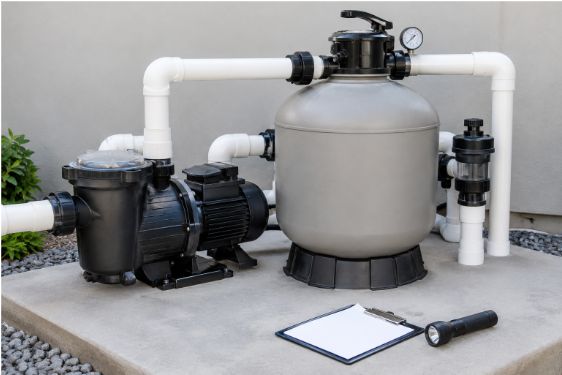
Ask to see the pool operating, the pump, filter, and heater. An appropriately qualified professional should evaluate any apparent movement or cracking. Look for leaking unions, rusty components, cracked housings, deteriorated valves, exposed wiring, and improvised repairs. Record equipment model numbers and ask about installation dates, service history, warranties, and whether replacement parts are still available.
A pressure gauge, filter tank, plumbing connections, and electrical components can all provide clues about maintenance. Buyers do not need to diagnose every part themselves, but they should not accept “it worked last season” as a substitute for observing the system in operation.
Water naturally leaves a pool through evaporation, splashing, backwashing, and routine cleaning. However, a pool that needs frequent refilling or has persistently wet soil near plumbing and equipment deserves further attention. Ask the seller how often water is added and whether prior leak repairs were completed.
The EPA notes that pool water can be lost through evaporation, leaks, cleaning, and splashing, while a properly used cover can substantially reduce evaporation. Its guidance on pool water efficiency is useful for understanding why a cover, routine maintenance, and prompt leak repairs matter in a hot climate.
Inspect the barrier around the pool, including fencing, gates, latches, doors leading from the home, alarms, ladders, handrails, drain covers, and any pool cover. Gates should close and latch properly, and furniture or equipment should not create an easy route over a barrier. Safety features should be tested before closing, not assumed to work because they are present.
The Consumer Product Safety Commission’s safety barrier guidelines for home pools describe layers of protection such as fences, self-closing and self-latching gates, door alarms, and safety covers. Buyers should also confirm applicable Austin-area requirements with the relevant local authority, homeowner association, or permitting office.
Request maintenance logs, service invoices, permits, warranties, equipment manuals, and receipts for major work. Ask directly about resurfacing, plumbing repairs, leaks, pump or heater replacement, and renovations. Compare the records with the pool’s visible condition and the inspector’s findings.
Build an ownership budget that includes cleaning, chemicals, electricity, water, seasonal service, repairs, and eventual equipment replacement. Include the potential need for future work on the surface, tile, coping, deck, fence, and safety devices. The goal is not to predict every expense, but to avoid budgeting only for routine cleaning while overlooking aging components.
A specialized pool inspection is particularly worthwhile for an older pool, unclear maintenance history, visible cracks, cloudy water, nonfunctioning equipment, or suspected water loss. A useful written report should identify observed conditions, describe recommended follow-up, and distinguish immediate safety concerns from items that need monitoring or repair.
For significant findings, obtain written repair estimates from qualified professionals. Then decide whether to request a specific repair, a seller credit, or a price adjustment. Keep requests focused on documented conditions, confirm any agreed work before closing, and retain invoices, warranties, and inspection reports for future reference.
A pool does not need to be flawless to be a sound part of an Austin home purchase. Buyers simply need a realistic view of its condition, safety, maintenance history, and likely future needs before closing day.